
 PL
PL

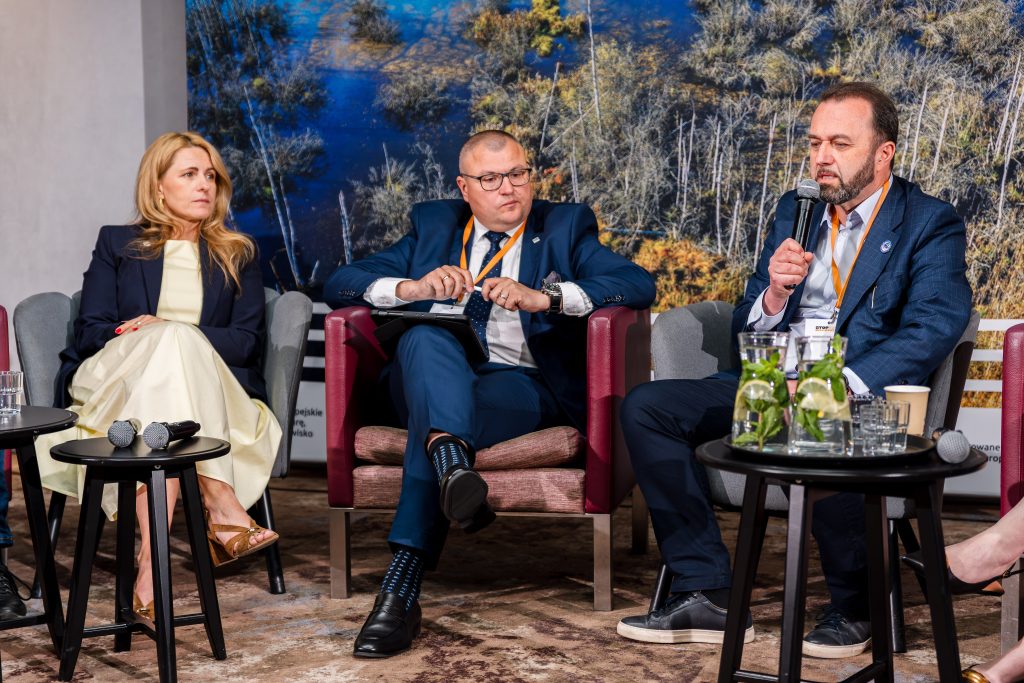
Experts, local government officials, and scientists analyzed mechanisms for combating drought during the conference “Stop Drought! Start Retention! – Time to Action!” held on June 17 in Gdańsk. The discussion focused on the proposed actions in the draft update of the Drought Effects Counteracting Plan (uDECP) for urban areas. Drawing on the experiences of Gdańsk, Łódź, and Poznań, the need for systemic legislative and educational changes was emphasized, as well as the importance of wetland protection and the role of comprehensive blue-green solutions in cities.
The main conclusion from the debate is clear: the future lies in renaturalization – a return to solutions developed by nature itself, carelessly “corrected” by human activity. The small-step approach and integrated water management are invaluable in this regard. During the discussion, Marcin Jarzyński, Deputy President of the State Water Holding Polish Waters, emphasized that fighting the drought crisis in isolation makes little sense. Effective resource protection requires a flexible network of connections between multiple entities. Since 2020, Polish Waters has organized nearly 4,000 meetings with local governments, representatives of the State Forests, and other water management stakeholders. President Jarzyński emphasized that without such coordinated action, the process of counteracting the effects of drought cannot be successful. He pointed, among other things, to the positive example of cooperation in the Stobrawa River basin. The focus was on the reconstruction of small dams and the construction of simple gates and weirs, which allowed for the effective irrigation of an area of over 330 hectares.
Agnieszka Hobot, project manager for the uDECP contractor, also spoke about the need for cooperation and the specific nature of the problem. She reminded everyone that Poland has been struggling with drought for years, and while it doesn’t receive as much media attention as a flood, its effects are just as serious. The expert also pointed out that selective, individual actions won’t yield the desired results, and that cooperation, especially between neighboring municipalities and residents within entire catchments, is key to successful drought mitigation. The expert emphasized that the new approach included in the uDECP is key. The previous plan consisted of a list of recommended actions, which, in practice, was rarely used because the tasks weren’t assigned to specific institutions. The document’s update, which is currently being developed, completely changes this. For the first time, a set of actions will be assigned to municipalities based on drought hazard and risk indicators, enabling more effective planning, including investment selection and allocation of support funds. She reminded everyone that, following public consultations, the uDECP will be formally adopted as a regulation by the Minister of Infrastructure.
The “Sponge City” philosophy in Gdańsk and Łódź
Ryszard Gajewski, president of the municipal company Gdańsk’s Waters, spoke about the revolution in thinking about urban space. The Tricity, enriched by the lessons of the 2016 flood, has completely redefined the concept of flood protection, transforming it into a blue-green retention strategy. The president explained that the philosophy is to use urban greenery to store water. A city designed this way operates in two phases. During the increasingly frequent, torrential rainfalls associated with global warming, the greenery absorbs excess rainwater, relieving the burden on storm sewers. Meanwhile, during dry periods, the stored moisture evaporates, naturally lowering temperatures and protecting the city from the bothersome urban heat island effect.
Aleksandra Sztuka-Tulińska, Deputy Director of the Environmental Management Department in the Department of Ecology and Climate at the City of Łódź Office, pointed out that modern cities must change their approach to spatial planning. Blue-green solutions are becoming increasingly important, including protecting river valleys and meadows, and eliminating the perception of wild areas as wastelands. Łódź is implementing this approach by systematically deconstructing its city center. Green zones and rain gardens are being created on streets and in the courtyards of tenement houses, and a network of pocket parks is being created in densely built-up districts as part of the “Green Polesie” program. The city has also increased the number of parks to 23, prioritizing minimally impacted forest parks where concrete is completely excluded.
The most innovative experiment, however, is the release of rivers trapped in underground channels, such as the Lamus and Jasień Rivers. Their beds are being loosened, cleansing vegetation is being introduced, and during storms, water is able to spread freely throughout the park, which recharges the groundwater and regulates the microclimate.
Legal barriers and the need for education
During the conference, it was recalled that the concept of drought appears 71 times in the Water Law in operational, planning, and administrative contexts. However, a key issue remains assessing whether the current legal framework adequately addresses the scale of the current hydrological crisis. Ryszard Gajewski, President of Gdańsk’s Waters, pointed out that the current law treats ecological solutions more strictly than traditional drainage infrastructure. While the construction of standard, concrete underground reservoirs poses no major formal challenges, creating a natural rain garden requires a water permit. The currently drafted act on increasing natural retention, which is intended to simplify these procedures, offers hope for local governments struggling with bureaucracy.
The conference recurred with the theme of education for virtually all social groups. Implementing modern, ecological projects in cities sometimes encounters resistance or misunderstanding. Aleksandra Sztuka-Tulińska noted that residents’ awareness is building slowly – urban projects are often well-received, but rather as image-building projects. She spoke about how, while mowing lawns less frequently is now popular and accepted as an effective way to retain moisture in the soil, for many people, taller grasses are still synonymous with neglect, not conscious climate protection.
Let’s take care of wetlands in the city
Professor Mariusz Lamentowicz from Adam Mickiewicz University in Poznań made an extremely important contribution to the debate. The scientist pointed out that instead of focusing solely on building new, artificial infrastructure, a key step for cities and municipalities should be a thorough environmental inventory. This must encompass not only what is visible to the naked eye on the surface, but also the geological structure of the substratum, including the vast carbon reserves locked in peat bogs. The professor warned that if we destroy a wetland or peat bog, we will never rebuild this invaluable resource.
Finance is a key issue in implementing the initiatives discussed during the conference. Louis Courseau, an expert in the Department of Climate Strategy and Resilience at the Ministry of Climate and Environment, addressed this issue. In his presentation, he presented a number of national and European mechanisms supporting the implementation of blue-green solutions. The speaker emphasized that various social groups, including private property owners, can benefit from financial assistance. An example is the “Microretention” program, which offers individuals subsidies of up to 90% of the costs (up to PLN 8,000) for rainwater collection and utilization systems, such as tanks and rain gardens.
Conference presentations are available on our website in the “Conferences”
The conference in Gdańsk was organized as part of an information and promotional campaign. Under the slogan “Stop Drought! Start Retention! – time for action!”, substantive debates are being held, expert podcasts are being recorded, and school meetings and competitions are being held. The entire campaign is supported by the project’s ambassador, actor Mateusz Banasiuk. He appears in the project’s promotional video, among others.
In Poland, the primary planning instrument for mitigating the effects of drought is the Drought Effects Counteracting Plan (DECP) and its current update. They are based on the guidelines of the EU Water Framework Directive and the Water Law Act. Pursuant to Article 185 of the aforementioned Act, this document is developed by Polish Waters and then adopted through regulations by the minister responsible for water management, currently the Minister of Infrastructure.
The first DECP was developed for the years 2021-2027. This document is updated at least every six years.
