
 PL
PL

Poland has entered another growing season with a water deficit. Dry, cracked soil and drying rivers are no longer regional anomalies, but a reality across large swaths of the country. The answer to these problems lies in the actions outlined in the currently updated Drought Effects Counteracting Plan. On June 17th – during the World Day to Combat Desertification and Drought – a conference will be held in Gdańsk under the slogan “Stop Drought! Start Retention! – Time to Act!”. Experts and practitioners will discuss real and necessary solutions.
Climate analyses confirm an extreme water deficit in May 2026. Due to a dry April, which brought only 32% of the normal rainfall (average less than 12 mm), and an equally rainless May, topsoil moisture in some areas dropped below 10%. The problem of low rainfall has been observed since the beginning of the year. In Warsaw, 75 mm of rainfall fell in the first five months of the year. According to the climatic norm, approximately 260 mm should have fallen during this period. This is less than 29% of the norm!
According to the latest reports from the Institute of Soil Science and Plant Cultivation – State Research Institute, agricultural drought is most severely affecting the Kuyavian-Pomeranian, Masovian, and Łódź voivodeships, followed by Greater Poland and Lower Silesia. Meanwhile, data from the Institute of Meteorology and Water Management – National Research Institute indicate rapidly progressing hydrological drought in rivers – the low-water zone dominates at over 60% of measurement stations. Official warnings against so-called Low water levels have affected the Noteć River basin, the Warta River, and the tributaries of the Oder and Vistula Rivers. Groundwater remains at risk due to low water levels across most of Poland. According to the latest hydrogeological warning issued by the National Geological Institute – National Research Institute, the risk of low water levels applies to 14 voivodeships.
Despite this, groundwater reserves in Poland remain at a safe level for public water supply. However, locally, the situation has worsened due to lower groundwater levels.
Every Drop of Water Matters
The currently updated Drought Effects Counteracting Plan (uDECP) is the most important document in our country regarding drought management. The first such document has been prepared for the years 2021-2027. Pursuant to Article 185, Section 8 of the Act of July 20th 2017 – Water Law, we must update the solutions contained therein at least every six years. The strategy is based on proposed actions in the most sensitive areas: agriculture, forestry, and urban areas. According to Marcin Jarzyński, Deputy President of Polish Waters for Flood and Drought, “This is precisely the greatest challenge we face: it is impossible to effectively counteract drought if we only act in selected areas. To double the water resources retained in the country, which is what we are striving for, we must act holistically. Every drop of water truly matters.” Rafał Jakimiak, coordinator of the “Stop Drought! Start Retention!” project, says that the actions outlined in the uDECP focus on increasing landscape retention: “Their main goal is to retain water where it falls, thereby improving local hydrological conditions. This will restore the natural water cycle, effectively mitigating the effects of drought.”
Concrete Actions to Combat Drought
In agriculture, the decades-long forced drainage has ended, in favor of a two-way drainage system. The reconstruction of facilities is intended to retain and distribute water in fields, rather than simply drain it. This is accompanied by the promotion of regenerative agriculture, which naturally rebuilds the soil’s water retention capacity, particularly by increasing humus content. The same applies to the ecosystems surrounding farmland.
In forest areas, a return to nature has become a priority through the removal of old drainage systems and drainage ditches. Forests are expected to act like a sponge, which will also be aided by the conversion of stands to species more resistant to climate change.
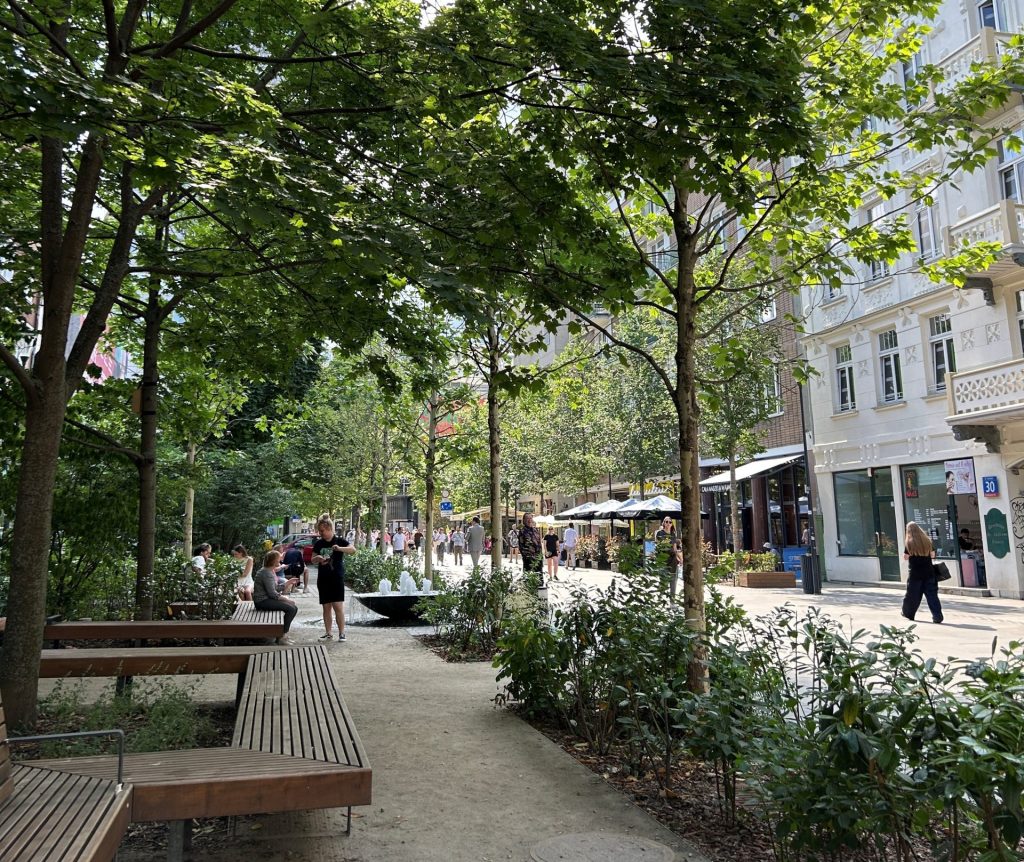
In cities, it is crucial to implement further blue-green infrastructure projects aimed at ending the era of concrete. The uDECP project envisions implementing, among other things, rain gardens, flower meadows, green roofs, and the use of permeable surfaces, which allow rainwater to soak into the ground instead of flowing unproductively into the sewer system.
Planning, Response, and Openness
The entire uDECP project assumes two modes of operation, depending on the current situation in the country. The first phase – preparation – is responsible for the long-term management of water resources and micro-retention. The second is the response phase, encompassing immediate crisis procedures and interventions when droughts occur. Importantly, the document is open-source, allowing experts, local governments, and practitioners to implement additional solutions as part of the drought management strategy.
In Gdańsk, Drought Control is Underway
Participants in the “Stop Drought! Start Retention! – Time for Action!” conference will discuss how to implement these changes in practice. The State Water Holding Polish Waters invites you to Gdańsk on June 17th (online participation is possible). The panel discussion will bring together scientists, engaged local government officials, government representatives, and practitioners. Together, they will discuss solutions aimed at intensifying water storage and legislative changes necessary to effectively protect our resources.
The work on updating the Plan is accompanied by an information campaign, because although we are learning more and more about drought, we still have much to do in terms of education. Substantive debates are being organized, expert podcasts are being recorded, and meetings are being held in schools, and the entire campaign is supported by the project’s ambassador, actor Mateusz Banasiuk. Every action we take in the fight against drought matters. Together, we can definitely do more!
More information can be found at www.stopsuszy.pl
The project, reviewing and updating the Drought Effects Counteracting Plan, was co-financed by the European Funds for Infrastructure, Climate, and Environment for 2021-2027.
