
 PL
PL

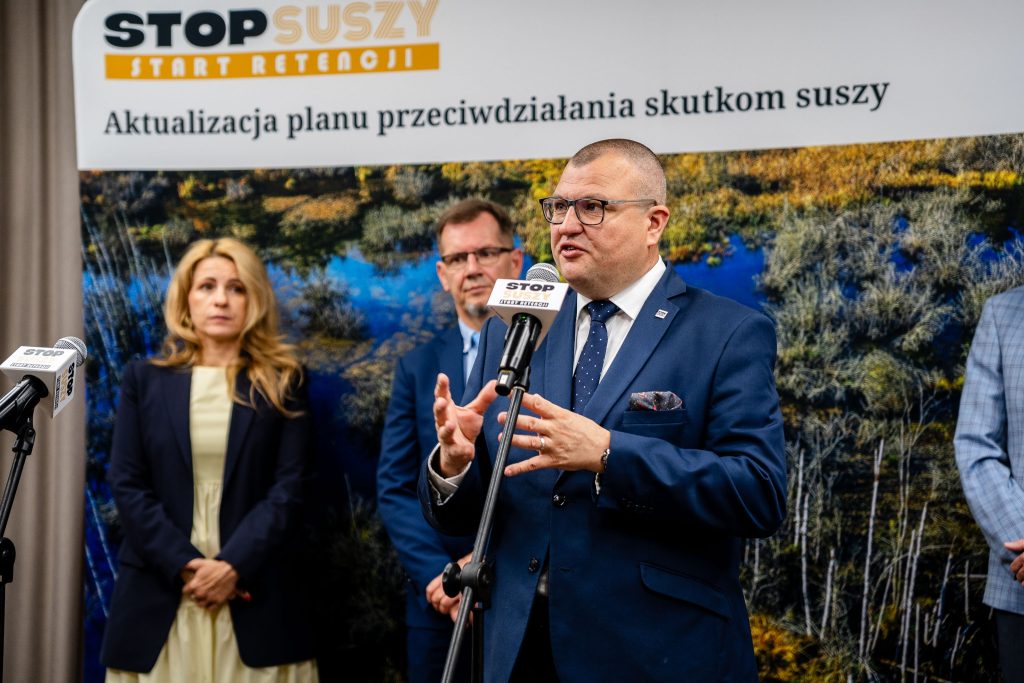
Over 450 experts and practitioners are debating in Gdańsk how to combat drought in the city. The meeting is taking place on the World Day to Combat Desertification and Drought. The choice of Tricity is not accidental – Gdańsk and Sopot are leaders in implementing blue-green infrastructure. The main topic of the conference “Stop Drought! Start Retention! – time for action!”, organized by Polish Waters, is the solutions proposed in the draft update of the Drought Effects Counteracting Plan.
Global warming has left no areas in Poland immune to its dangerous effects. Drought is the most important of these. The primary concern is the situation in agriculture. Reports from the Institute of Soil Science and Plant Cultivation, National Research Institute, and the Institute of Meteorology and Water Management indicate that 62% of municipalities across Poland are experiencing agricultural drought. But that’s not all.
In the first ten days of June, the situation remained difficult not only in fields but also in rivers and other watercourses. According to the Institute of Soil Science and Plant Cultivation and hydrological reports, hydrological drought persisted in many river basins, and below-average water flows continued to be recorded, particularly in the west and north of the country. The Institute of Soil Science and Plant Cultivation cautions that while increases following storms were noted in some regions, these increases were not sustained enough to significantly reverse the drought situation nationwide.
Updated Drought Effects Countermacting Plan as a response to threats
The main topic of the Gdańsk conference was the solutions proposed of Poland’s most important strategic document for combating drought – the draft update of the Drought Effects Countermeasures Plan (uDECP), which Polish Waters is working on.
For decades, the traditional engineering approach has been based on a simple principle: rainwater should be drained as quickly as possible into rivers, and consequently, into the Baltic Sea. The effects of this strategy are being acutely felt right now, and a key assumption of the uDECP, not only for agriculture but also for cities, is retaining water in the landscape. This is to be achieved in many ways. Primarily, by promoting micro-retention as a planning standard and establishing flower meadows and rain gardens. Equally important should be the elimination of sealed surfaces, i.e., concrete, the widespread use of water-permeable surfaces on parking lots and sidewalks, and the protection of urban wetlands and natural floodplains.
The dangerous paradox of modern cities
Modern cities, especially large ones, suffer from both water shortage and excess. Concrete-lined city centers act like a hot frying pan, exacerbating the urban heat island phenomenon and rapidly evaporating any remaining moisture. When a heavy downpour arrives after a dry spell, the rock-dry soil is unable to absorb the water. Instead of replenishing aquifers, rainwater floods the streets, causing a flash flood. Within hours, the water flows into the sewer system, leaving the city dry again, negatively impacting the ecosystem. “Drought cannot be treated solely as a problem for farmers and foresters – it has become a real threat to urban infrastructure, industry, and the daily comfort of everyone’s lives. The legal framework implemented by the updated DECP and examples developed by cities such as Gdańsk demonstrate that retention is key to surviving the era of weather anomalies. Every drop of water is important,” said Marcin Jarzyński, Vice President of Polish Waters, during a briefing at the “Stop Drought! Start Retention!” conference.
Integration of planning, i.e. linking water management with urban spatial development, following the example of Gdańsk solutions.
Leaders of the blue-green revolution
While many Polish cities are just beginning to catch up, Gdańsk (along with Sopot) has emerged as a leader and become a benchmark in the field of blue-green infrastructure. Gdańsk’s strategy is based on the philosophy that stormwater is not “wastewater” to be disposed of, but a valuable resource that should be retained where it falls. The city has set itself an ambitious strategic goal: achieving 1 million m³ of retention capacity by 2030. This is the equivalent of 400 Olympic-sized swimming pools filled to the brim. The fight against drought and flooding is being pursued in two ways: through large-scale hydrotechnical projects and distributed micro-retention. Gdańsk’s Waters already manages a network of over 200 rain gardens, drainage basins, and bioretention ditches.
Small is beautiful
Unlike other large cities that opt for spectacular solutions, Gdańsk integrates micro-retention directly into the existing street network. Instead of high curbs that block drainage, the city uses lowered curbs and special street outlets. These redirect dirty water from the road directly into green basins. There, specially selected plants (e.g., irises and rushes) filter pollutants and slowly release clean water into the ground. These solutions work in two directions: during heavy rains, they protect the city from flooding, and during droughts, they cool the surrounding area and nourish urban greenery.
Pioneering river restoration projects are also being implemented in Łódź. A flagship example is the partial uncovering and restoration of the Lamus River in Kiliński Park. The river once powered mills and the city’s industrial development, but in the late 19th century, it was diverted underground into a tunnel and eventually began to function as a municipal sewer. Now, rainwater will be purified using natural methods and will relieve the sewer system, supplying the park.
Developers and education under the microscope
Gdańsk has also introduced some of the most stringent planning regulations in Poland. A developer building a new housing estate or commercial facility has a legal obligation to retain a specific volume of water on its own property through rain gardens or, for example, green roofs.
Education is an equally important pillar of the fight against drought. The city authorities emphasize that the protection of water resources begins on private properties. It is about building awareness that micro-scale retention carried out by thousands of citizens gives real drought-immunity to the entire ecosystem.
Work on updating the Plan is accompanied by an information campaign. Substantive debates are organized, expert podcasts are recorded, and meetings are held in schools, and the entire action is supported by the project ambassador – actor Mateusz Banasiuk. Every action we take in the fight against drought matters.
The update of the Drought Effects Counteracting Plan (uDECP) represents another important step towards integrated water resources management in Poland. For the first time, a set of measures will be assigned to municipalities based on drought hazard and risk indicators, enabling more effective planning, including investment selection and the allocation of support funds. The document will become a practical tool, not just a strategy – enabling public administration and local communities to act in a coordinated and knowledge-based manner.
In Poland, the primary planning instrument for mitigating the effects of drought is the Drought Effects Counteracting Plan (DECP) and its current update. They are based on the guidelines of the EU Water Framework Directive and the Water Law Act. Pursuant to Article 185 of the aforementioned Act, this document is developed by Polish Waters and then adopted through regulations by the minister responsible for water management, currently the Minister of Infrastructure.
The first DECP was developed for the years 2021-2027. This document is updated at least every six years.
More information can be found at www.stopsuszy.pl
The project, the review and update of the Drought Effects Counteracting Plan, was co-financed by the European Funds for Infrastructure, Climate, and Environment for 2021-2027.
